

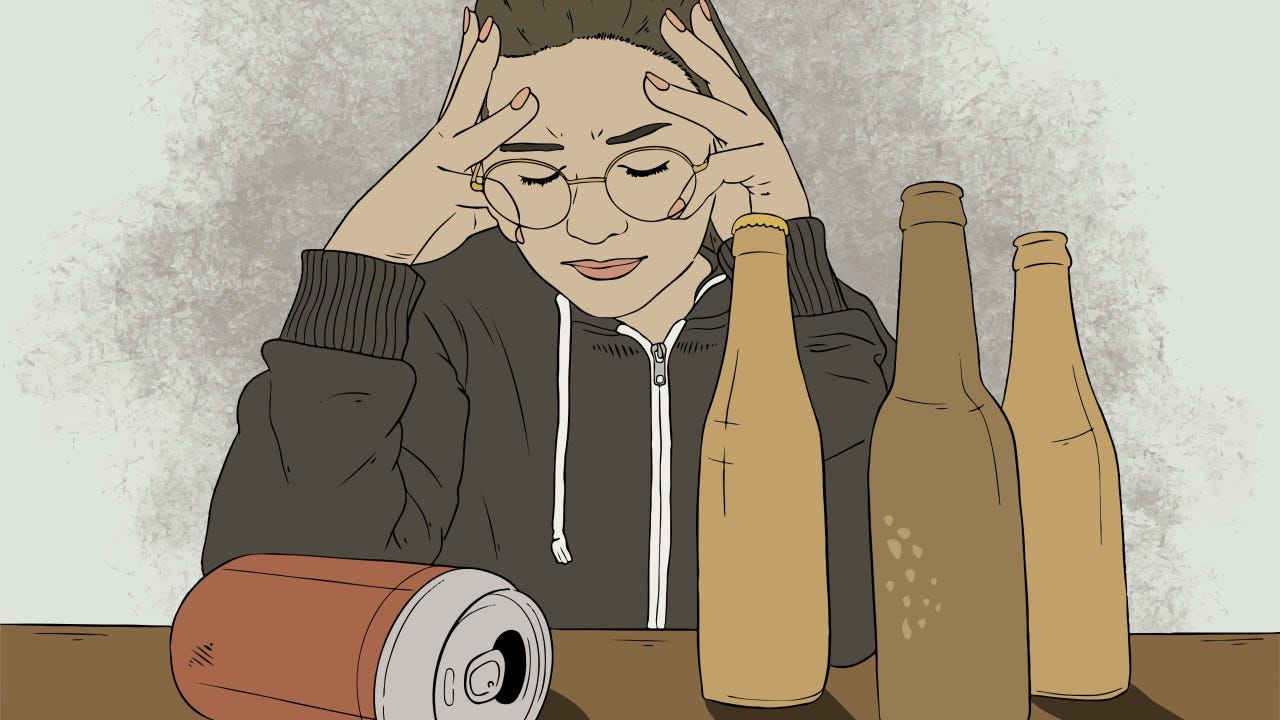
I never called a helpline. I never sat in a circle. I never walked through the door of an addiction service.
Not because I didn’t have a problem. I did. I knew I did. But for years, the idea of reaching out for help felt like walking into a room that had been designed for someone else entirely. Someone in more obvious trouble. Someone who had lost more. Someone who had finally hit the kind of rock bottom that makes the decision for you.
I was still functioning. Still working. Still convincing myself - and most of the people around me - that everything was fine. Which meant, by the logic of the system that existed to help me, I didn’t quite qualify.
I am eight years sober now. And I work in this space professionally. So when the Institute of Alcohol Studies published its 2025 report, Barriers to Recovery: Overcoming Obstacles to Alcohol Recovery in the UK, I read it carefully and with genuine respect. It is thorough, well-evidenced, and important. It identifies real barriers - underfunding, stigma, the saturation of alcohol in our culture, the lobbying power of the drinks industry, the absence of a coherent national strategy.
All of it true. But all of it worth fixing.
And yet something nagged at me as I read it. Because the report, like most of the policy conversation around alcohol harm, is largely about improving access to a system. What it doesn’t fully address is the vast population of people who will never approach that system - not because access is too difficult, but because they don’t believe it was built for them.
The 78% Nobody Is Talking About
The IAS report includes a striking figure: only 22% of people who need specialist alcohol support in England are actually accessing it. That means 78% - nearly 472,000 people - are out there without help.
The report frames this, understandably, as a failure of provision. More funding, better services, lower thresholds. All necessary. But I’d argue there’s a prior failure, one that sits upstream of all of those solutions.
Most of those 472,000 people are not standing at the door of a service, unable to get in. They haven’t approached the door at all. They are people who are worried about their drinking, who know on some level that something has to change, but who have never once considered calling a helpline or booking an appointment to talk about it.
Why? Because the very architecture of help-seeking asks something of them they’re not yet ready to give: a label. An admission. A crossing of a threshold that, once crossed, cannot be uncrossed.
The person drinking too much on a Tuesday night, alone, telling themselves it’s under control - they are not thinking about treatment pathways. They are thinking about whether anyone has noticed, and whether they’d be believed if they said they needed help.
What “Services Weren’t Built For Me” Actually Means
I want to be precise about this, because it’s easy to misread.
It isn’t about quality. Many addiction services in the UK are staffed by extraordinary people doing genuinely important work - often under impossible conditions, with budgets that have been cut by 27% in real terms since 2013.
It’s about a signal. Every touchpoint in the journey toward help sends a signal about who it’s for. And for a significant portion of people drinking harmfully - professionals, high-functioning individuals, people for whom alcohol is a private management strategy rather than a public crisis - the signal has always been: not quite you.
The signals that kept me at a distance:
The threshold of severity. Services, implicitly and sometimes explicitly, are oriented toward dependency and crisis. If you’re not there yet, there isn’t much for you.
The requirement to self-identify. Every pathway begins with an act of naming - “I have a problem with alcohol” - that many people are years away from being ready to make.
The social register of help. Groups, clinics, referrals. All valuable. All carrying associations - with a particular kind of problem, a particular kind of person - that can feel alienating to someone who doesn’t yet see themselves in that story.
The absence of privacy. Asking for help, in most of its forms, involves telling someone. A GP. A counsellor. A group. For people whose drinking is hidden - even from themselves - that exposure can feel more frightening than the drinking itself.
None of these are arguments against improving services. They are arguments for recognising that improved services, on their own, will not reach the 78%.
The Gap the Report Doesn’t Quite Name
The IAS report calls for a “no wrong door” approach - the idea that wherever someone enters the system, they can be directed to the right support. It’s a good principle, and I support it.
But it still assumes someone has found a door.
What the policy conversation has been slower to grapple with is what sits before the door. The 2am thought that never becomes a phone call. The moment of clarity on a Sunday morning that dissolves by Monday evening. The person who types something into a search engine and then closes the tab because nothing that comes up feels like it’s for them.
There is a growing body of thinking - and early evidence - around the role that low-barrier digital support can play in this pre-contemplative space. Not as a replacement for clinical services. Not as a solution. But as a first point of contact that doesn’t ask someone to be ready. That meets them where they are, at the hour they’re in it, without requiring them to name themselves as someone with a problem before they’ve arrived at that conclusion themselves.
This category of support is still largely missing from the mainstream policy response to alcohol harm. The IAS report, to its credit, is thorough in cataloguing structural and systemic barriers. But the innovation gap - the question of what reaches people before they’re ready for what we’ve built - is one the sector is only beginning to take seriously.
What Reducing This Barrier Actually Requires
If we’re serious about reaching the hidden majority - the people who are worried but not yet ready - the design requirements look quite different from anything the current system offers.
It needs to be private, in the deepest sense. No digital footprint. No record. No-one finding out.
It needs to be available at the moment the thought surfaces - which is rarely during office hours.
It needs to be non-clinical in register, warm rather than procedural, a conversation rather than an assessment.
It needs to ask nothing of the person in terms of readiness. No commitment required. No label accepted in advance.
And it needs to be capable of holding ambivalence - because the person at this stage isn’t sure they want to change, and any approach that pushes too hard will simply lose them.
That is not a description of a helpline. It is not a description of an app that tracks your units. It is a description of something the sector hasn’t fully built yet, and that policy documents are only beginning to gesture toward.
A Final Thought
Eight years ago, I didn’t reach for the help that existed. Not because I didn’t need it, but because nothing about it told me it was mine to reach for.
The IAS report is a serious and necessary piece of work. It identifies real failures in a system that has been chronically underfunded and politically neglected. The recommendations - more funding, Equality Act reform, minimum unit pricing, a new national strategy - deserve to be taken seriously and acted on.
But I’d invite anyone working in this space to sit with one additional question: what are we building for the people who will never come to us?
Because until we answer it, the 78% stays where it is.
David Henzell is a sobriety coach, founder of the Phenomenal Sobriety Ltd. and an advocate for reaching the people alcohol services don’t currently reach. He has been sober for eight years.