

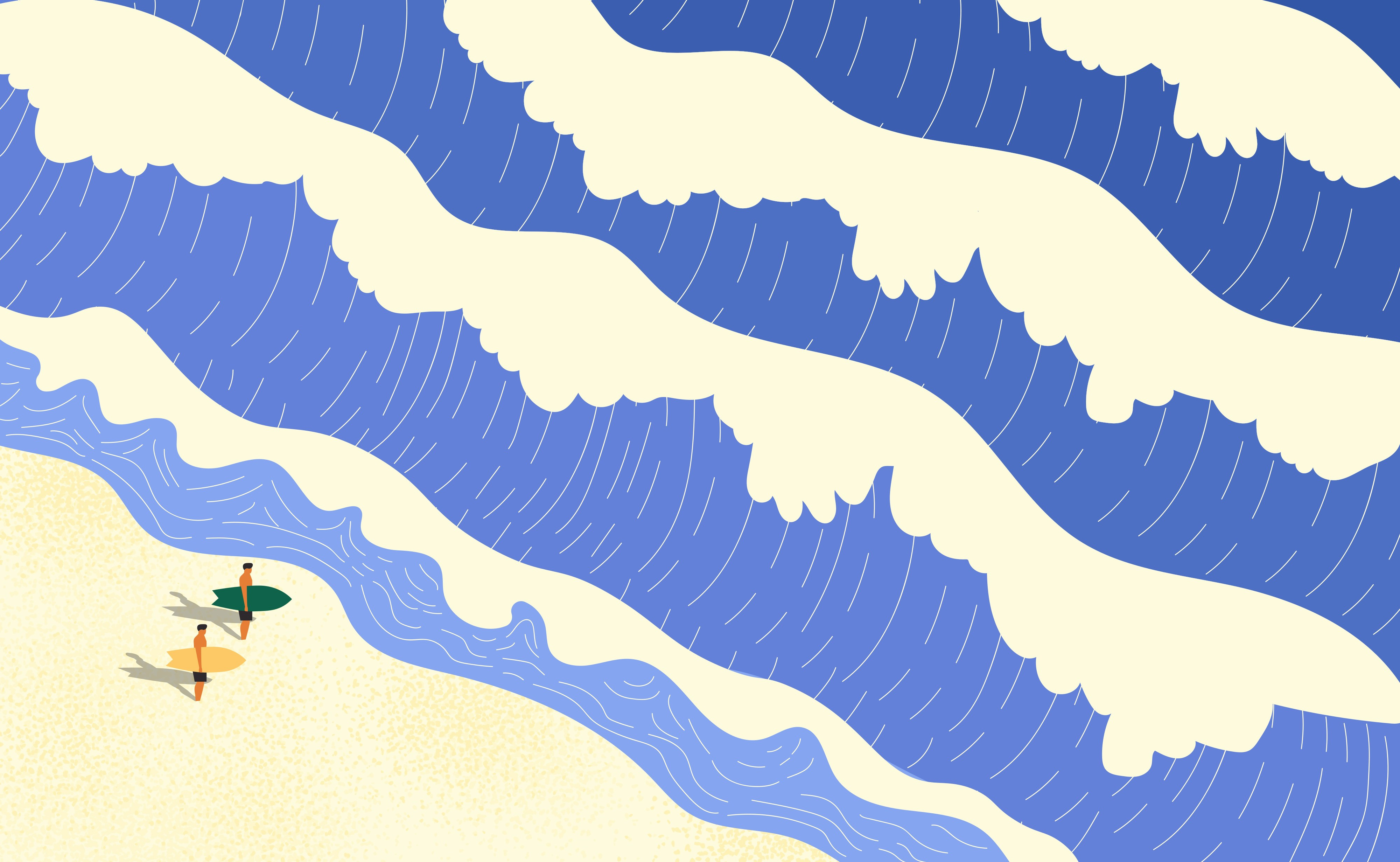
A woman in California runs a surf therapy programme called Waves of Recovery. Before she founded it, she went through her own version of what she now treats, burnout first, then addiction. What she remembers about the first time she paddled out wasn’t relief. She’s described it as closer to something waking up, a feeling of being alive and being free that she hadn’t felt in a long time.
Everyone in her programme wears a wetsuit. Nobody wears makeup. She’s said this matters more than it sounds like it should, because it means the people she’s helping see her as a person walking alongside them in the water, not a clinician delivering something from a chair. The hierarchy that most treatment carries without meaning to, the expert and the patient, the one who has the answers and the one who doesn’t, dissolves somewhere around the second wave.
You see, none of this is a new idea dressed up in modern language. Victorian doctors prescribed sea air and sea bathing for conditions they didn’t fully understand. Cold water swimming has quietly become one of the more talked-about mental health practices of the last decade. The ocean has been medicine, informally, for a lot longer than formal medicine has existed in its current shape.
On the other side of the Pond there’s a British charity called Turn to Starboard, which takes military veterans sailing to help them process trauma. One of the men who went through it now crews tall ships as they circumnavigate the UK, raising money for the charity that took him in. He didn’t describe the sea as calming when he talked about what it gave him.
He talked about it reminding him he was still alive.
That phrase is doing more work than it looks like. Calm is what you feel when a nervous system settles. Alive is something else. It’s closer to an encounter, meeting something bigger than the version of yourself that’s been struggling, and being met back by it.
Researchers have started catching up to what sailors and surfers and Victorian sea-bathers already knew by feel. There’s a growing body of work on what some call blue space, the idea that proximity to water does something specific to a nervous system that green space alone doesn’t quite replicate. Lower heart rate, lower stress hormones, a kind of attention that settles rather than scatters. It’s still early science, and none of it claims water is treatment on its own. What it confirms is that the feeling these two charities describe isn’t just a nice story people tell about their programmes. Something measurable is happening in the body before the mind has caught up enough to explain it.
Here’s where it would be easy, and wrong, to land my point. The easy version says the sea wins, the wild and the unscripted are what actually heal people, and the structured stuff, the assessments and the appointments and the treatment plans, is the thing to escape. I don’t think that’s true, and I don’t think the people running these programmes think it either. Turn to Starboard and Waves of Recovery both work precisely because they sit alongside formal treatment, not instead of it. Nobody in either story stopped seeing their therapist because they got in a boat.
What I think is actually happening is that structure and freedom aren’t in competition. They’re doing two different jobs. Both of them, done properly, are load-bearing.
There’s a man whose work I’ve kept close for years, close enough that it stopped feeling like theory a while ago and started feeling like conversation with an old friend, even though we never met and he died before I was born. Viktor Frankl spent years in concentration camps and came out the other side with a theory about what actually keeps a person going when almost everything else has been stripped away. He didn’t think it was comfort, or the absence of suffering. He thought it was meaning, and he built an entire school of therapy on the roads that lead to it. One road was through work, through doing something, a deed, a task, a contribution. Another was through encounter, meeting someone or something and letting it matter to you. He never wrote a word about addiction per se, but I’ve spent enough of my own working life inside his ideas to notice that the shape of what he found fits it almost exactly.
The formal side of recovery, the steps, the meetings, the structured programme, tends to supply meaning through the first road. You show up. You do the work. You carry something. The man from Turn to Starboard didn’t just receive help, he became crew on a ship carrying a flag for other veterans. The woman who founded Waves of Recovery didn’t stay a client, she built something. Both of them moved from being helped to helping, and that movement, the deed, is one of the load-bearing walls.
This is also the part of recovery I think formal services can be genuinely good at, and it’s worth saying so plainly. A good structured programme is a machine for turning duty into meaning on the days you have none of your own to spare. It gives you the next right thing to do when you can’t yet feel why it matters. That’s not a small thing. It’s the scaffolding a lot of people need before they can stand in the water at all.
The wild, unscripted side supplies meaning through the second road. The wave that reminds you you’re alive doesn’t ask you to have earned it. It doesn’t care what step you’re on, or whether you’ve even said out loud yet that you have a problem. It just meets you, usually before you’ve had time to think your way into or out of the feeling. That’s the other load-bearing wall, and it’s worth noticing that it doesn’t require a label first. You don’t have to have decided you’re in recovery for a cold sea or an early swim to do this to you. Sometimes the encounter comes before the decision, not after it, and it’s part of what makes the decision possible.
Take either wall away and something starts to sag. A programme that’s all duty and no encounter turns into going through the motions, doing the right things for reasons that have gone quiet somewhere along the way. A life that’s all encounter and no duty turns into a string of good feelings with nothing holding them together, no thread running from one wave to the next. People need both doors open at the same time. Most recovery that actually holds, in my experience, has always had a version of both running underneath it, even when nobody involved would have used this language for it.
I’ve spent enough years around people at very different points in this, some who haven’t said the word addiction out loud yet, some years into a programme, some long past needing one, to notice that the ones who keep going aren’t the ones who found the one correct method. They’re the ones who kept both doors propped open. The duty when the feeling wasn’t there. The encounter when the duty had gone stale. Neither one is a failure of the other.
So if you’re reading this and trying to work out whether what you’re doing counts, whether the walk, the swim, the meeting, the thing you can’t quite name yet, is the right shape for recovery, I’d gently suggest that’s the wrong question. The question worth asking is smaller and more honest. Did this give me something to do that mattered. Did this wake something up in me that I’d stopped expecting to feel. If either answer is yes, you’re standing on a load-bearing wall, whatever it looks like from the outside, whatever anyone ever told you recovery is supposed to look like.
The deed matters. So does the wave. Neither one is the detour.
Drawing on reporting from The Guardian: “The rise of blue-space therapy: how the sea is helping people deal with trauma, anxiety and addiction”.