For nearly nine years I have spoken publicly about recovery. About what it took, what it cost, and what it gave back.
Somewhere along the way, without really noticing, I had stopped being someone who had recovered from alcoholism. I had become Recovery itself. The proof of it. The evidence.
And proof, I was learning, has to be maintained.
This is the article I probably should have written sooner.
Inspired by Lauren Kennedy West
I watched a video last night that I haven't been able to stop thinking about.
Lauren Kennedy West has schizoaffective disorder. For years she documented her life with it - honestly, rawly, in real time - and then she began following a strict ketogenic diet and something remarkable happened. Her symptoms reduced dramatically. She worked with her psychiatrist, carefully adjusted her medications, and began to speak publicly about what metabolic therapy had done for her mental health. She was brave enough to say out loud what many people didn't want to hear: that recovery was possible, that it was happening, that she was living evidence of it.
And then, more recently, her brain slipped into a brief psychosis.
She made a video about it. And in it she said something that stopped me in my tracks.
She said that somewhere along the way, without really noticing it happen, she had stopped defining herself by her illness and started defining herself by her wellness. By her stability. By being proof that recovery was possible. And when reality broke through - when the symptoms returned despite everything she had built - it wasn't just frightening. It was destabilising to her entire sense of self. Because the self she had built was contingent on remaining well.
At the end of the video, quietly, she asked: "Who am I when I'm not proving anything?"
I sort of laughed when I heard that. Not unkindly, of course. I laughed because I recognised something in myself that I hadn't quite found the words for until that moment.
Let me tell you about a cold evening in Warsaw, early 2018.
I had been sober for around six months. I'd come through two medical detoxes, found my footing through group work and peer support, and slowly, haltingly, begun to rebuild something that felt like a life. I was living in Muranów - a neighbourhood with a weight of history in its streets - and that particular evening I had spent the day exploring the city, returning to my apartment as the temperature dropped and the night went still.
I ran a bath. I opened the bedroom window. And afterwards I dried off and lay down on the bed.
The curtains billowed inward. But there was no wind.
A warmth moved through me - slowly, completely, like something passing through rather than arriving. The room was utterly silent. And then, as suddenly as it had come, it stopped. The curtains fell back into place. And I heard myself say out loud, to no one, to the empty room, to whatever that moment was:
"That was my addiction. It's just said goodbye. It's gone now. I'm safe."
I have never fully known what to make of that moment. Whether it was spiritual, psychological, something else entirely - I've turned it over many times and I still don't have a clean answer. I've come to think that maybe I'm not supposed to. What I know is that it felt like a crossing. Like I had moved from one place into another and something had quietly closed behind me.
I was safe. I was recovered. I was free.
That moment became, without my fully realising it, the foundation on which I built everything that came next.
I went on to work as a recovery coordinator, and eventually left the constraints of formal services to do something I felt more passionately about - coaching people through sobriety on my own terms, creating tools and content and conversations that might reach people who would never walk through the door of a traditional service. It felt meaningful. It still does. There is nothing quite like the moment a person realises they are going to be okay.
But somewhere in the building of all of that - the work, the identity, the public voice - something shifted in a way I didn't truly notice until Lauren named it.
I had stopped being someone who had recovered from alcoholism. I had become Recovery itself. The proof of it. The evidence. And proof, I was learning, has to be maintained.
The gap between who I am in public and who I am in private can feel, on the harder days, like carrying a badly packed rucksack on a long walk. The weight is real but distributed wrong, shifting in ways you can't always predict or explain. I have my contradictions - we all do, though some of mine sit at an uncomfortable angle to the image that recovery work can project. There are habits I haven't shed, vulnerabilities I haven't resolved, aspects of my very human life that exist quietly alongside the coaching and the content and the thought leadership, as they do for every person alive. I manage them, mostly. But managing is not the same as integrating. And integration, I think, is what I had been missing.
I have coached clients through their darkest moments within hours of living through some of my own. Within hours of losing my dog. Within hours of losing my father. I held the space for their pain while mine waited in the corridor outside, patient and familiar. I am honest with my clients - more honest than most, I think - but even my honesty has a structure to it. I share my own difficulties only when I can contextualise them, only after the session is done, only as part of a gentle we're all the same, really on the way out. I let people in. But I choose the door. And some part of me has always known that choosing the door is not the same as being fully seen.
When clients ask me - and they do, often - "How did you get sober? When did you know you were better?" I have an answer I give. A good one, I think. A useful one. It talks about detox and community and SMART recovery and the slow accumulation of better days.
It doesn't mention the curtains.
It doesn't mention the warmth that moved through a silent room, or the words I said out loud to no one, or the sense I had of something departing that had lived in me for years. I've never known quite how to offer that moment without it sounding like something other than what it was. And so it stays inside, turned over privately, unshared.
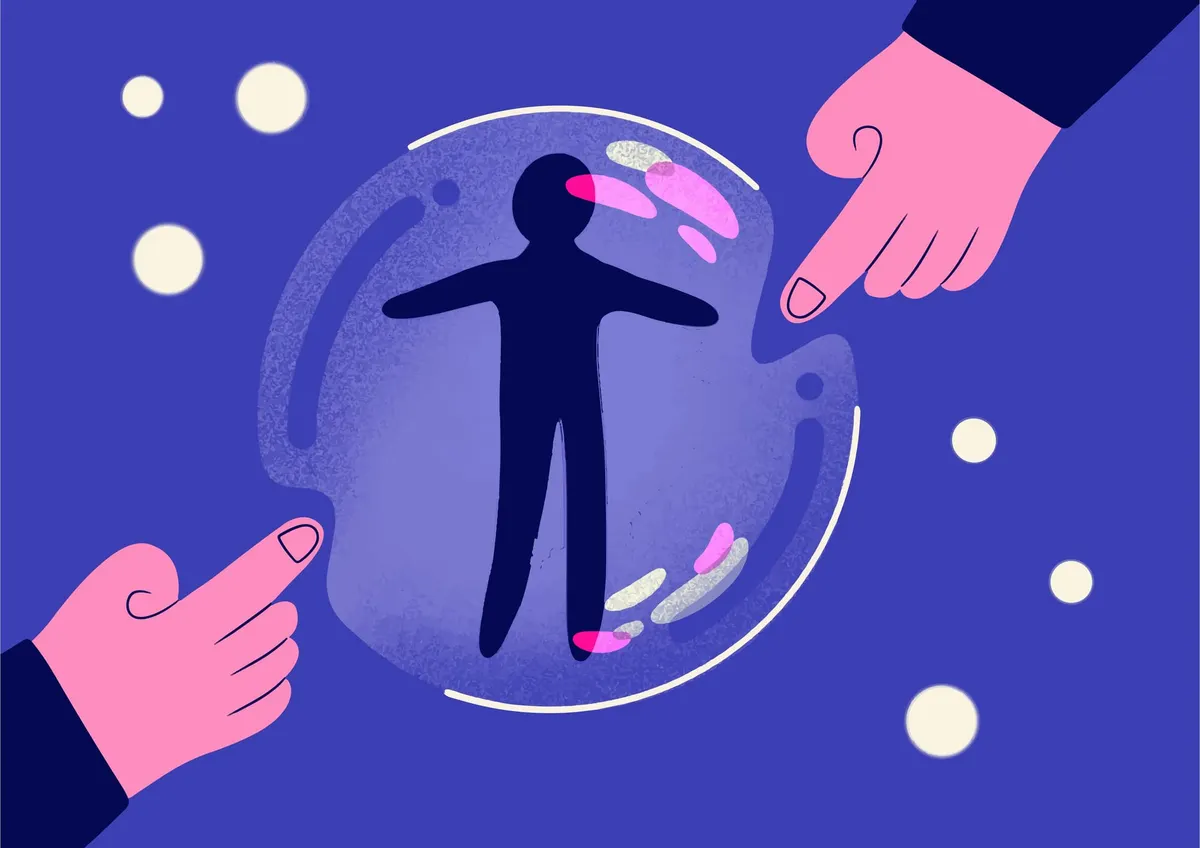
Because that moment is undefended. And undefended is dangerous when your identity is built on being proof.
This is what Lauren's video broke open for me.
She had attached safety to distance, she said. Distance from symptoms, from medication, from the version of herself who had been most unwell. As if healing meant she would never again be vulnerable to the thing she had healed from. And I understood that completely, because I had done the same thing - not with medication, but with identity. With the careful, gradual construction of a self that was defined by how far it had come from where it started.
The people I work with all carry versions of this weight too. I see it in them. The ones who have been sober for years and still feel vaguely fraudulent. The ones who are terrified that one bad day will erase everything they've built. The ones who have quietly started to believe that recovery is a performance with no interval and no understudies, and that if they slip out of character for even a moment the whole thing will unravel.
We don't talk about this honestly enough. We talk about recovery as a destination - a place you arrive at and then inhabit. We don't talk as much about what it costs to maintain the arrival. About the way the identity can slowly, imperceptibly, become its own kind of cage.
Lauren ended her video without a neat conclusion. She said she was still in the middle of it. Still injured, still waiting, still sorting through what safety means in a life that is genuinely, stubbornly unresolved.
I want to try to do the same.
I am recovered. I know that to be true in a way that is bone-deep and unshakeable - a cold Warsaw evening told me so, in language I couldn't argue with. But I am also still human, still contradictory, still carrying things I haven't fully set down. And those two truths are not in conflict. They are just both true.
I can be a sobriety coach and still have my own unfinished business. I can speak about healing and still be someone who is healing. I can have had a moment that felt like grace - like something holy passing through a still room - and also know that grace is not armour. It doesn't make you untouchable. It just makes you, perhaps, more honest. More willing to sit with both realities at once. More willing to say: I have come so far, and I am still on the way.
To the people I work with: you are allowed to be this complicated. Recovery was never a single moment, however luminous. It is the long, human, imperfect work of learning to carry both what you've been through and who you are now, without letting either one of them be the whole story.
And to Lauren, if she reads this: you asked who you are when you're not proving anything. I think you're this - honest, searching, willing to sit in the unresolved middle and speak from it anyway. That's not a failure of recovery. That's the most recovered thing I've ever seen.
I'm still learning to do it myself.
Lauren Kennedy West documents her journey on YouTube. This piece was written in response to her recent video on psychosis, identity, and the complicated territory of recovery. I'm grateful for her honesty, which gave me permission for mine.