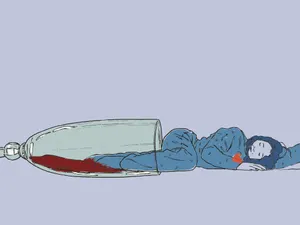
Daniel ended up in A&E at 2am on a Tuesday.
Not because he'd fallen down drunk. Not because he'd done anything particularly dramatic. His body had simply decided it had had enough of him treating it like a waste disposal unit for alcohol.
The doctor was blunt. "Your liver's struggling. Your blood pressure's concerning. You need to stop drinking for at least 60 days."
He'd been drinking since he was 17. Not problematically, he told himself. Just normally. The way everyone does. Pints after work. Wine with dinner. Beers whilst watching football. The entire social architecture of his life was built around alcohol. He agreed to 60 days because he had to. What he didn't expect was that those 60 days would completely dismantle everything he thought he knew about his relationship with alcohol.
Working with Dan, I watched this transformation unfold, and it revealed something remarkable about what's actually possible when someone commits to real change.
The First Uncomfortable Truth: He Had No Idea How Dependent He'd Become
The first week was strange for him.
Not because of physical withdrawal symptoms. He never shook or sweated or felt ill. The weirdness was subtler and somehow more disturbing. He couldn't sleep. For years, he'd used alcohol as a sleep aid. A few drinks, get drowsy, fall asleep. Simple. Except now, lying in bed completely sober, his brain refused to shut down. He'd lie there for hours, frustrated, convinced he needed alcohol to sleep.
What he didn't know then was what the science would later confirm: alcohol disrupts the sleep architecture in ways we don't notice when we're in the habit. The second half of the night becomes fragmented. REM sleep gets suppressed. You wake up thinking you slept, but your brain never actually rested.
Dan had created a perfect trap. Alcohol was destroying his sleep quality, which made him tired, which made him drink more to "help" him sleep, which made his sleep worse. And because he'd never experienced what real sleep felt like, he had no reference point to know he was trapped.
By day 10, something shifted. He woke up and his head felt different. Clearer. Like someone had cleaned a window he didn't know was dirty. At work, he noticed he could hold more complex information in his head without having to write everything down. Conversations became easier. He stopped losing his train of thought mid-sentence.
The brain fog he'd been living with for years wasn't normal. It was a direct result of regular alcohol consumption. Within a fortnight of stopping, his brain began re-establishing baseline cognitive function. He'd spent years thinking he was just a bit scatterbrained. Turns out he was just a bit drunk.
The Social Gauntlet: Testing Sobriety in Real Life
The real test came at week three.
His mate's 18-year-old son was having a birthday party. Exactly the kind of event where everyone drinks. Where not drinking makes you the odd one out. He went armed with zero-alcohol Guinness and a knot in his stomach about how awkward it would be.
Here's what he learned: nobody cared. The anxiety he'd built up about being the sober one at a party was entirely in his head. People were too busy enjoying themselves to monitor what was in his glass.
The bigger revelation came later in the evening. Watching people get progressively more drunk, he saw his previous behaviour reflected back at him. The repetitive conversations. The increasingly poor decisions. The gradual slide from charming to tedious. Being sober gave him a perspective he'd never had before: he could see what he'd looked like for the past 20 years.
And it wasn't flattering.
The Lads' Holiday: The Ultimate Stress Test
Week six brought the real challenge: the fabled lads' holiday to Tenerife.
This wasn't a holiday with some drinking. This was a holiday where drinking was the entire point. Four days of sun, football, and beer. That was the plan. He told his mates beforehand he wasn't drinking. Got the usual banter about being boring, about ruining the vibe. But they accepted it.
What happened over those four days surprised him. He enjoyed himself more than he had on previous trips. He was present for every conversation. He remembered every moment. He woke up each morning feeling energised instead of wrecked. He actually experienced the holiday instead of stumbling through it in an alcoholic haze.
The other lads adapted. After the first day, nobody mentioned it. They still had the same laughs, the same banter, the same connection. The alcohol had never been the source of the enjoyment. The people were. He'd just convinced himself otherwise for years.
What Actually Happens to Your Body
By day 60, the physical changes were undeniable.
Dan actually lost 8 kilograms without trying. His "beer belly" had shrunk noticeably. His face looked different - less puffy, clearer skin. He could walk up stairs without getting out of breath. His blood pressure, which had been concerning enough to land him in A&E, had normalised completely.
But the most remarkable change was happening inside, invisible to the eye. Even after years of heavy alcohol use, the liver can recover a significant portion of its original mass and function following alcohol removal. His doctor confirmed his liver fat had reduced by an estimated 15-20%. His liver was literally regenerating itself. The organ he'd spent 20 years poisoning was healing faster than he expected.
Fast forward week eight, he noticed something unexpected. He felt calmer. More level-headed. Less anxious about everything. He'd always assumed he drank to cope with stress and anxiety. But what he was experiencing suggested something different.
Chronic alcohol exposure creates a state where baseline dopamine activity drops below normal. This contributes to anhedonia - that feeling where things that should be enjoyable feel flat or unrewarding. The alcohol wasn't solving his anxiety. It was creating it. It was the drinking that had been making him anxious, restless, never satisfied. Within the first few weeks of stopping, his brain began relearning how to regulate itself without chemical intervention. By week eight, that relearning was complete. He felt genuinely calm for the first time in years.
The Moderation Question: Why He Chose Complete Abstinence
People kept asking him if he'd go back to "moderate" drinking after the 60 days.
He'd considered it. Maybe just weekends. Maybe just special occasions. Maybe just a couple of pints here and there. But he knew himself well enough to recognise the truth: he doesn't have an off switch. One pint becomes two. Two becomes four. Four becomes "I'm not sure how I got home." The moderation conversation was always a negotiation with himself that he'd eventually lose.
Complete abstinence was actually easier than moderation. It removed the constant decision-making, the internal bargaining, the justifications. He made it simple: none. And somehow, that simplicity made it sustainable in a way moderation never could have been.
What Daniel Gained by Giving Up
The transformation wasn't just physical. It was comprehensive.
Sleep quality improved dramatically. After the initial adjustment period, he started sleeping better than he had in years. Deep, restorative sleep. Waking up genuinely refreshed instead of groggy and thick-headed.
Mental clarity returned. The brain fog lifted completely. His focus sharpened. His memory improved. He could think clearly and maintain concentration for extended periods without his mind drifting or forcing itself to refocus.
Emotional stability emerged. The baseline anxiety that he'd carried for years diminished significantly. He felt more emotionally regulated, less reactive, more grounded. The constant low-level agitation that he'd normalised was gone.
Physical health improved across every metric. Beyond the weight loss and normalised blood pressure, he had more energy. He looked healthier. He felt stronger. But more than that, he felt like he was actually inhabiting his own body again.
Authentic connection deepened in his relationships. He was more present in conversations. He remembered what people told him. He showed up as his actual self rather than a slightly numbed version. The people he cared about got the real version of him, not the one filtered through alcohol.
And perhaps most significantly, he'd proved something to himself: he could change a deeply ingrained pattern. That he had more agency than he'd believed. That he wasn't controlled by habit, even when that habit was as embedded as alcohol had become.
The Cultural Reckoning
Dan's journey exposed something uncomfortable about how we relate to alcohol.
Alcohol is so deeply embedded in our social fabric that choosing not to drink is seen as unusual. Abnormal. Something that requires explanation and justification. The assumption is that everyone drinks, and if you don't, something must be wrong with you.
But here's what Dan discovered: there's a massive population between "social drinker" and "alcoholic" who are experiencing significant health impacts that go unrecognised because their consumption falls within cultural norms. He never identified as alcohol-dependent. He had a good job, a family, a normal life. He wasn't drinking in the morning or hiding bottles. He was just drinking the way everyone around him drank.
And it was destroying his health.
The invisible cost of "normal" consumption is that it's normalised to the point where we don't recognise the harm. We don't see it. We don't talk about it. We just accept that this is what life looks like.
Beyond 60 Days: The Decision That Changed Everything
So, day 60 came and went.
Dan had completed the doctor's "assignment". He could theoretically go back to drinking if he wanted to. But he didn't want to.
The experiment had revealed a truth he couldn't ignore: his life was objectively better without alcohol in it. He had more energy, better health, clearer thinking, deeper relationships, and genuine presence in his own life. Why would he trade that for the temporary pleasure of a drink?
The 60-day experiment became a permanent lifestyle change. Not because he had to. Because he wanted to. That's the difference between punishment and privilege. One is imposed. The other is chosen.
What This Means
I'm not suggesting everyone needs to stop drinking.
But if you're reading this and recognising yourself in parts of his story, that recognition matters. If you've ever wondered whether your drinking is affecting your health, your sleep, your mental clarity, or your relationships, you already know the answer. The question isn't whether alcohol is having an impact. The question is whether you're ready to discover what life looks like without it.
You don't need to hit rock bottom to make a change. You don't need to identify as an alcoholic to benefit from sobriety. You just need to be curious enough to try. Sixty days is long enough to experience the physical transformation. Long enough to test it in real social situations. Long enough to discover whether the benefits outweigh what you're giving up.
For Dan, they did. Dramatically.
The power to stop drinking was always in his hands. He just needed a reason compelling enough to use it. A 2am trip to A&E gave him that reason.
You don't have to wait for a crisis to make a different choice.