Turns out I spent years looking for something that didn't exist.
Not a cure. Not a quick fix. Not someone to tell me I was broken and needed saving.
I needed an approach that treated me like an intelligent adult who'd made some poor choices, not a powerless victim who needed to surrender to a higher authority. I needed support that recognised I had a career, a family, responsibilities. I needed someone to meet me where I was, not where a manual said I should be.
I never found it.
And I spent a long time thinking the problem was me.
The Numbers Behind the Silence
Here's what the statistics reveal, and it's worth sitting with for a moment: England has an estimated 600,000 alcohol-dependent adults. Of those 600,000 people, only 18% receive any form of specialist treatment.
That's not a gap. That's a chasm.
I was part of that 82%.
Not because I didn't recognise the problem. I absolutely did. Not because I didn't want help. I desperately did. But because the help available didn't recognise me.
That's the thing nobody really talks about.
What I Actually Looked Like
I was a successful professional. I'd built a career in advertising, run my own brand design agency, lectured at universities. From the outside, everything looked fine. Thriving, even.
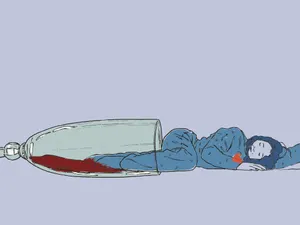
From the inside, I was drowning in a bottle and couldn't find a lifeline that made sense.
The traditional recovery narrative painted me as someone who'd hit rock bottom, lost everything, needed to admit complete powerlessness. But I hadn't lost my job. I hadn't lost my family, yet. I hadn't crashed my car or ended up in hospital, yet.
I was what people call "functional" - a term that masks how dysfunctional things actually are.
Functional meant I could keep showing up. Keep performing. Keep convincing everyone - including myself - that everything was under control. Functional meant the problem was invisible, which meant it was easy to pretend it didn't exist.
But it did exist. And it was getting worse.
The gap between "everything's fine" and "my life has fallen apart" is where most people actually live. And there's almost no support designed for that space.
The Shame That Keeps People Hidden
When I finally admitted I needed help - and that admission took far longer than it should have - the first barrier I hit wasn't logistical. It wasn't about finding the right programme or having the time or money.
It was shame.
I'd spent my career solving problems, creating solutions, helping others build their brands. How could I admit I couldn't solve this one problem in my own life? How could I say out loud that I'd lost control of something?
The research backs up what I experienced: stigma is one of the most prominent barriers to treatment-seeking. People avoid getting help because they're "too embarrassed to discuss it with anyone" and they feel they "should be strong enough to handle it alone."
There's a peculiar kind of loneliness that comes with that thinking. You're isolated not because you're geographically alone, but because you believe you should be able to handle this by yourself. You're a failure if you can't. You're weak if you need help.
So you don't ask for it.
And the longer you don't ask for it, the worse things get, and the more ashamed you become, and the less likely you are to reach out.
It's a vicious cycle.
The Framework Mismatch
When I finally found a recovery programme and walked into a meeting, I was desperate for help. I was ready. I was willing.
But I also felt utterly disconnected.
The stories people shared were valid, real, important. But they weren't my story. The language they used - the frameworks, the steps, the terminology - felt foreign. The identity they were asking me to adopt felt like wearing someone else's shoes. Uncomfortable. Ill-fitting. Ultimately unsustainable.
I understand the intention behind traditional approaches. For many people, they work beautifully. They provide structure, community, a sense of belonging. I don't doubt that.
But for me, and for thousands like me, those approaches felt like they required a specific profile, a specific narrative, a specific identity.
You had to fit the box to get the help.
And if you didn't fit the box, you convinced yourself that either the help wasn't for you, or the problem wasn't actually a problem.
The People in the Middle
There's a quiet revolution happening in how people relate to alcohol. The data shows it clearly: nine in ten UK drinkers are now trying to moderate their drinking in some way - up from 84% just seven years ago.
Think about that. In seven years, the number of people actively trying to change their relationship with alcohol jumped 6%.
These aren't crisis interventions. These aren't people who've hit rock bottom. These are people who've recognised something isn't quite right and want to address it before it becomes catastrophic.
They want support that meets them in that middle ground - the space between "everything's fine" and "my life has fallen apart."
Traditional approaches often operate at the extremes. You're either fine and don't need help, or you're in crisis and need intensive intervention. There's little acknowledgement of the vast territory in between where most people actually live.
I spent years in that middle ground. Knowing something was wrong. Trying to fix it myself. Failing. Trying again. Getting worse. Telling myself it wasn't that bad. Then hitting a moment where I couldn't pretend anymore.
But I still didn't fit the crisis narrative. I still didn't want to be told I was powerless. I still wanted to be treated like an intelligent adult who needed guidance, not broken goods who needed fixing.
What I Was Actually Looking For
When I finally started looking seriously for help, here's what I needed:
I needed someone to treat me like a capable adult, not a broken individual.
I needed evidence-based approaches that respected my intelligence instead of asking me to adopt a belief system on faith.
I needed flexibility that accommodated my busy life - my career, my family, my responsibilities - instead of demanding I reorganise everything around a rigid programme.
I needed to build community without being required to adopt a specific identity or belief system as the entry fee.
I needed someone who understood that my path wouldn't look like everyone else's, and that was okay.
I needed to understand that sobriety wasn't about deprivation and punishment. It was about building something better.
Most of all, I needed someone who understood that the problem wasn't that I was broken. The problem was that my coping mechanism had become a liability.
The Invisible Population
I think about the 82% of the 600,000 people who need help but don't get it.
Not all of them are like me, but many of them are. They're professionals with good jobs. They're parents trying to be present for their kids. They're people with responsibilities, with reasons to sort this out, with the capacity to do it - but without the framework that actually speaks to them.
They're invisible because they don't fit the public narrative about addiction. They haven't lost everything. They're still functioning. They're still showing up.
But they're drowning.
And they're convinced that the help available isn't designed for people like them.
So they stay quiet. They try to handle it alone. They tell themselves they'll sort it out when circumstances are better, when they have more time, when things aren't so busy.
The circumstances never get better. Things never get less busy. And the problem doesn't go away - it compounds.
The Cost of the Gap
The statistics are sobering: 22,644 alcohol-related deaths in England in 2023 - a 21.3% increase from 2016. That's 40.7 deaths per 100,000 population, the highest rate since records began.
Behind each of those numbers is someone. Someone who perhaps thought they'd address it later. Someone whose family thought things weren't that bad yet. Someone who didn't fit the stereotype and therefore didn't think the help was for them.
Someone who was part of that invisible 82%.
I could have been one of those numbers.
The only reason I'm not is because I eventually found a way forward - not because the system worked for me, but because I kept searching long enough to find something that did.
But how many people don't keep searching? How many give up looking because they've tried the available options and they don't fit? How many convince themselves the problem isn't really a problem because they don't match the image of addiction that dominates public consciousness?
The Question Nobody's Asking
Here's what I've never understood: why is there so little support designed for the space in between crisis and fine?
Why are we building recovery frameworks for people at the extremes and ignoring the vast population living in the middle?
Why are we requiring people to fit specific narratives, adopt specific identities, surrender to specific belief systems in order to get help - when the evidence shows that people need choice, autonomy, and respect to actually change?
Why are we losing the 82%?
I don't have clean answers to those questions. But I think they're worth asking.
Because every person in that 82% is someone's partner, someone's parent, someone's friend. Every person is drowning in a way that's invisible to everyone watching. Every person is convinced that the help available isn't for them.
And most of them are right. The help available isn't designed for them.
What This Actually Means
The gap I couldn't fill when I was searching for help isn't small. It's not an edge case. It's not a minority of people falling through the cracks.
It's the majority of people who need help.
It's the professional who's successful on paper but drowning behind closed doors. It's the parent who wants to be more present for their kids. It's the person who recognises something isn't working but doesn't fit the crisis narrative. It's the intelligent adult who needs guidance but won't accept being told they're powerless.
It's the 82%.
And right now, that gap is mostly filled with silence.
With people trying to handle it alone. With shame. With the quiet conviction that they're the problem, not the system that can't serve them.
I spent years in that silence. Looking for something that didn't exist. Convinced that the problem was me.
It wasn't until much later that I realised: the problem wasn't me. The problem was the gap.
And that gap is still there. For 600,000 people. For maybe millions more who haven't quite admitted to themselves that they need help.
The question is: how long do we let that gap exist before we start building something that actually serves the people living in it?