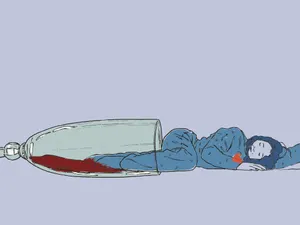
There's a graphic memoir doing the rounds this week - Anxietyland by illustrator Gemma Correll. The Guardian ran a big feature on it. It's about a life spent inside anxiety: the dissociation, the confusion, the spiralling, the hospitalisation. It's being called brave and funny and honest.
It is all of those things.
But the detail that stopped me wasn't in the headline. It was a line buried in the coverage: that Correll's anxiety years included a period of alcohol abuse.
That detail won't surprise many of you reading this.
Because if you've lived with chronic anxiety - the background hum kind, or the full-body-shutdown kind - you've probably discovered at some point that alcohol works. At least for a while. It quiets the noise. It flattens the edges. It makes a room full of people feel survivable. What almost nobody tells you is that it also feeds the very thing you're trying to quieten. And that over time, you don't just have an anxiety problem. You have an anxiety-and-alcohol problem, and each one is making the other worse.
Correll puts it simply at the end of her story: giving up alcohol didn't solve all of her problems - but it was a good start. I think that's the most honest thing anyone has written about sobriety in a long time. And it's exactly what this article is about - not the finish line, but the door that opens when you stop using alcohol to manage something it was never going to fix.
The Loop Nobody Explains
Alcohol actually does reduce anxiety. That's the problem.
This isn't a myth. Alcohol acts on the GABA receptors in your brain - the same system targeted by anti-anxiety medications like benzodiazepines. It slows the nervous system down. The chest tightens a little less. The spiral in your head pauses. So when someone tells you that drinking to manage anxiety doesn't make sense, they're wrong. It makes complete sense. It works - immediately, reliably, and without a prescription.
The problem is what happens next.
As alcohol leaves your system, your nervous system doesn't just return to baseline. It overcorrects. The suppression lifts, and anxiety surges - often higher than before you drank. This is sometimes called rebound anxiety, and it's why the morning after drinking often feels dread-soaked even if nothing bad has happened. Your brain registers this anxiety. Your brain also remembers that alcohol fixed it last time. The next time anxiety shows up - which is now more frequent, because your nervous system is more sensitised - the pull toward a drink is stronger.
This is the loop. Anxiety → drink → brief relief → more anxiety → drink again. Over months and years, the dosage increases and the relief window shortens. Many people never realise this is what's happening. They just know they need a drink.
Why It's So Easy to Miss
Both problems can be invisible from the outside.
Correll's memoir makes exactly this point - her drawn world was confident and in control. The reviews noted it was almost a shock to learn what was happening beneath the surface. High-functioning anxiety and high-functioning drinking often look, from the outside, like someone who has their life together. Which makes it very lonely to be the person on the inside.
Most people who drink to manage anxiety have never actually looked at it that way. They drink at parties because that's what you do at parties. They have a glass of wine after a stressful day because they deserve it. They get through family dinners because that's what family dinners require. Each occasion has its own explanation. The explanations are all plausible. What's missing is the single picture that emerges when you line all those occasions up together - and look honestly at what was happening just before each one.
That picture is often clarifying in a way that's uncomfortable and necessary at the same time.
It doesn't mean you're an alcoholic. That word carries so much baggage it's almost useless as a starting point. What it means is that you have a functional relationship with alcohol - it's doing a job for you. And that job is managing anxiety you haven't yet found another way to handle.
What Actually Changes Things
This is where most articles stop. Notice the pattern. Be mindful. Consider your relationship with alcohol. It's good advice as far as it goes - but noticing a loop and being able to step out of it are two entirely different things.
What I do with the people I work with is go further. Not just identifying that anxiety is driving the drinking, but understanding what's underneath the anxiety - the specific triggers, the situations, the beliefs that keep the whole system running. Because if anxiety is driving your drinking, working on the anxiety changes the equation. The drink stops being the solution the moment you have other solutions. That's not naive optimism. It's how this actually works.
The people who come to me thinking they have a drinking problem often discover they have an anxiety problem that drinking was temporarily solving. Addressing both - at the same time, in the same process - is what makes the difference between white-knuckling through sobriety and actually not needing a drink anymore.
Those are completely different experiences. One is endurance. The other is freedom.
A Place to Start
If you're reading this and recognising the loop - if you drink to get through situations rather than enjoy them, if the morning after feels heavier than it should, if anxiety and alcohol have become quietly intertwined in your daily life - that recognition matters.
You don't have to have it figured out. You don't need a label or a crisis or a rock bottom moment. You just need to be curious enough to look at it honestly.
That's usually where it starts. And it's exactly the kind of conversation I'm here to have.